
A growing number of users are realizing that, rather than battling with companies to maintain their privacy at the application level, they should look to private hosting. Privacy-focused servers enable users to gain complete transparency and control over their data by self-hosting applications, as well as build websites, blogs, and apps that are private from the ground up. This is never more true than with an anonymous virtual private server (VPS).
That said, it can be difficult to know which providers promise privacy but don't deliver. And, of those who do, which still offer a good user experience?
Our assessment criteria
We've examined over a dozen privacy VPS providers across the following criteria so that you don't have to, covering:
- Sign-up: What PII is required? What are the KYC triggers, if any?
- Payment privacy: Does the host support cryptocurrency for private payments? If so, which coins, and using which infrastructure? Are there third parties involved, or is payment processing done in-house?
- Infrastructure & features: What hardware is the provider using, what regions and OSes do they support. Are there bandwidth caps? What's their uptime like? Do they have modern features such as KVM, DDoS protection, domain management, and one-click application provisioning?
- Data collection & control: What data does the provider collect (log) and what do they do with it? How easy is it to destroy the data from your servers and accounts?
- Customer support: Does the company maintain an active, reachable support presence, or are they largely unreachable if you have questions or problems?
- Developer support: What tools does the provider have to make life easier for developers? Do they have an API, CLI, etc., to help provision and manage servers?
- User sentiment: Most private VPS providers face issues with poor reviews by customers who break the terms of service and then get angry when their account is suspended. What we're looking for, then, is primarily complaints about hardware/network quality, support response times, or providers who are outright scammers and never launch a server in the first place. Even so, we don't think it's fair to knock providers entirely to the bottom of the list based on user sentiment. We're very aware of issues such as review brigading and dark PR (in both directions).
Out of these, we of course gave the highest weight to privacy-related criteria and support. Providers that have great privacy but middling hardware are more likely to rank highly than one with good hardware but privacy-invasive practices.
That said, the private VPS landscape is full of shady practices and misleading marketing claims. Since we don't want to recommend providers that will scam you, we further split providers into three groups: "best", "use with caution", and "not recommended". We'll explain what each of these ratings means in its dedicated section.
Like what BitLaunch does? Sign up for a private VPS today and talk to our support for some free credit.
What we didn't test
While we would have loved to pay for and provision servers for every provider on this list, that simply wasn't feasible within the scope of this article. Many require users to commit to a month or more of server time up front or come with scam warnings, not to mention the time investment. To get a true assessment of a provider, you need to use them for a month or more.
You should therefore see this article as an expert deep dive into publicly available information, combined with quick tests of support, account creation, and networking infrastructure.
A note on bulletproof hosts
Several VPS providers have been excluded from this list entirely because they are so-called "bulletproof" hosts. These hosts explicitly allow users to perform illegal activities such as hacking, spam, hosting CSAM, phishing, or terrorism. Supporting these hosts supports the activities they allow on their servers and gives the entire private hosting industry a bad name.
If the moral reasons are not enough, know this. Bulletproof hosts are already operating illegally. If they'll happily support terrorism, they aren't going to turn their noses up at scamming you. Even if they don't, you'll run into persistent issues with IPs being banned, outages due to law enforcement raids, and so on. It's just not worth it.
Round-up: The 5 best VPSs for privacy, performance, and support
If you don't have much time, you'll find our quick recommendations below. That said, we strongly recommend you read on. Binary scores don't express the nuances of each provider, which may heavily influence whether they are well-suited for your particular use case.
| Provider | Anonymity | Networking | Hardware | Support | User Sentiment | Developer API |
|---|---|---|---|---|---|---|
| BitLaunch | ★★★ | ★★★ | ★★★ | ★★★ | ★★★ | ✓ |
| Servers.guru | ★★★ | ★★★ | ★★★ | ★★★ | ★★★ | ✓ |
| VSYS.host | ★★★ | ★★★ | ★★★ | ★★★ | ★★★ | ✗ |
| njal.la | ★★★ | ★★★ | ★★★ | ★★★ | ★★★ | ✗ |
| Navicosoft | ★★★ | ★★★ | ★★★ | ★★★ | ★★★ | ✗ |
| nicevps.net !Use with caution — support policy threatens to bill users €180/hr for tickets deemed unnecessary. | ★★★ | ★★★ | ★★★ | ★★★ | ★★★ | ✗ |
| Cloudzy !Use with caution — allegations of being a front for an Iranian company, with reports that a significant portion of its servers support malicious activity. | ★★★ | ★★★ | ★★★ | ★★★ | ★★★ | ✓ |
| REGXA !Use with caution — deceptive corporate structure, misleading marketing, and inconsistent support. Negative reviews are partly DMCA-related rather than scam reports. | ★★★ | ★★★ | ★★★ | ★★★ | ★★★ | ✗ |
| MonoVM ✕Not recommended — requires full name and address on sign-up, poor privacy practices, and a misleading Trustpilot score displayed on its own homepage. | ★★★ | ★★★ | ★★★ | ★★★ | ★★★ | ✗ |
| MangoHost ✕Not recommended — mandatory KYC on sign-up, privacy-invasive trackers, and shares data with third parties. Not suitable for users with genuine anonymity requirements. | ★★★ | ★★★ | ★★★ | ★★★ | ★★★ | ✗ |
| VPS Server ✕Not recommended — no cryptocurrency support, immediate KYC on login, sells user data for advertising. Should not be considered an anonymous host. | ★★★ | ★★★ | ★★★ | ★★★ | ★★★ | ✗ |
| AnonVM ✕Not recommended — linked to pfcloud (raided by authorities in 2024), suspected fake reviews, and multiple reports of servers never being deployed. | ★★★ | ★★★ | ★★★ | ★★★ | ★★★ | ✗ |
| LightNode ✕Not recommended — mandatory KYC after sign-up, Facebook pixel tracking, and non-existent support. Anonymous branding is misleading. | ★★★ | ★★★ | ★★★ | ★★★ | ★★★ | ✓ |
You'll notice that the number of quality, trustworthy anonymous VPS hosts is very few; really, we would hesitate to wholeheartedly recommend any outside of the top three.
Before we get into that, however, it's worth giving some background on what a private VPS is, how they work, and why you'd want to use one.
What is a private VPS?
A private or anonymous VPS is a virtual private server that you can buy and operate without directly tying your legal identity to the account. This is typically achieved by using privacy-oriented payment methods, minimizing sign-up data, and reducing logging/tracking to the minimum levels required to run the service.
It's important to understand that a VPS being marketed as private doesn't mean that you don't need to worry about your privacy at all. Many providers collect some information that could indirectly tie you to your legal identity (such as your IP address) to identify and prevent abuse of their services. A privacy VPS is not a substitute for the general practices you should follow if you want to stay more private online.
Common use cases of privacy VPSs
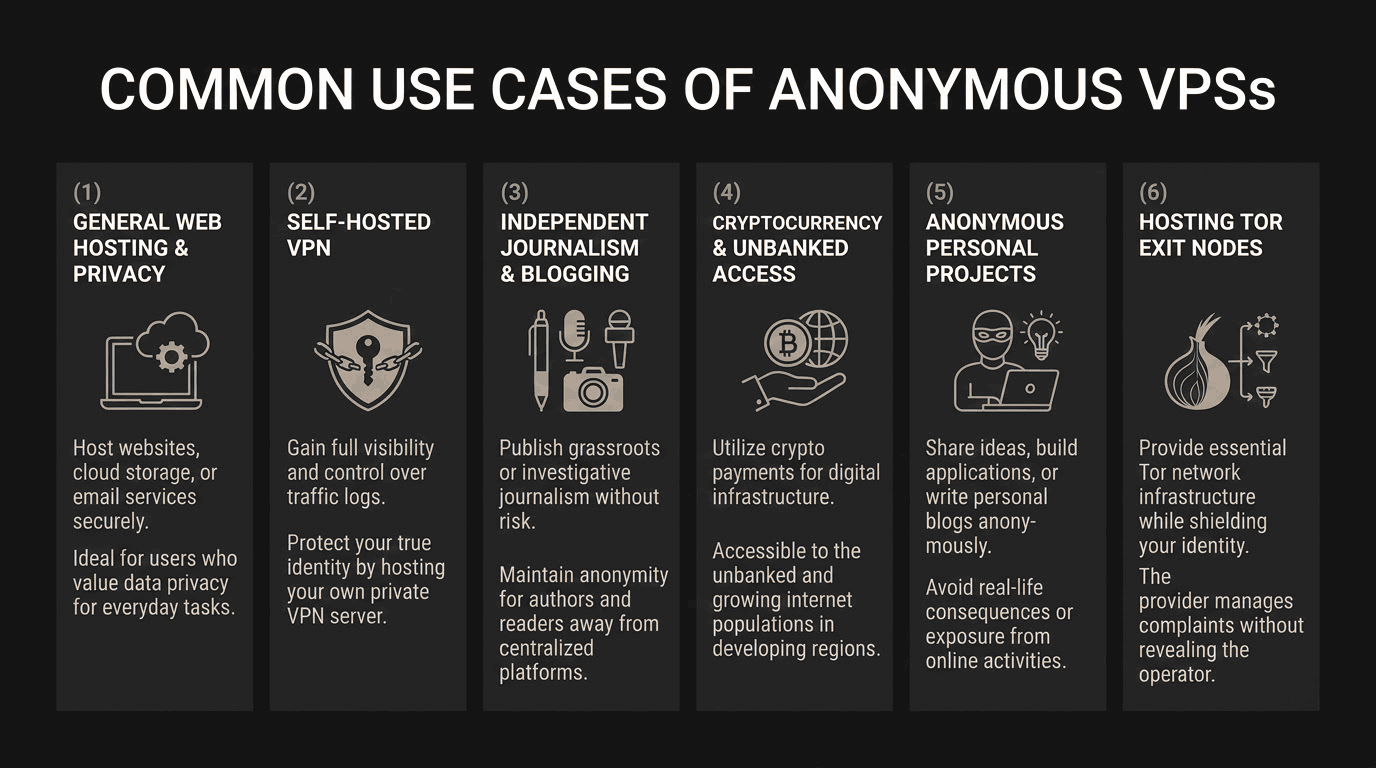
The number one myth we see with anonymous VPS use is that it's synonymous with bad intent. This hearkens back to the common fallacy that "if you've got nothing to hide, you have nothing to fear". In reality, most customers use privacy VPSs for completely normal and mundane tasks such as web hosting, cloud storage, email, development, game server hosting, etc. They're just normal, everyday people who also happen to greatly value their privacy.
That said, there are some use cases that privacy-focused VPSs are uniquely well-suited to.
VPN hosting
One of the main reasons to use a VPN is to protect your privacy, so self-hosting a VPN on privacy-first infrastructure just makes sense. It enables you to gain full visibility and control over what information is being logged, without the risk that your true identity will be exposed by your provider.
Journalism & blogging
Grassroots, independent journalism is making a comeback as many internet users and writers lose faith in mainstream media outlets. Rather than delivering content on platforms that may or may not protect their own privacy and that of their readers, journalists can host their own blog on a private VPS.
Unbanked access
Any reputable privacy VPS provider will offer cryptocurrency as a payment method. This is perfect for the world's growing unbanked internet population. By our count, regions such as middle Africa have recently experienced a 40% year-over-year growth in internet users despite 70% of its population lacking a bank account. Privacy VPSs can deliver vital infrastructure without locking it to MEDCs with expansive banking and identification systems.
Personal projects
If people wanted their friends and family to read every thought they posted online, they wouldn't sign up to Twitter or Reddit with anonymous handles. The truth is that many people want to be able to publish content, host a website, or run their own applications without consequences in their real lives if they're seen by the wrong person or something goes wrong.
Hosting Tor exit nodes
Tor exit nodes often come under pressure since the associated IP address is viewed as the source of all traffic, and not all traffic may be legitimate or legal. Hosting an exit node on an anonymous VPS provider shields you from some of that scrutiny — the provider deals with the complaints, yet is unable to directly link you to the node (provided you use an anonymous email address). Just make sure your VPS provider allows Tor exit nodes and you inform them before starting one.
The benefits of privacy VPSs
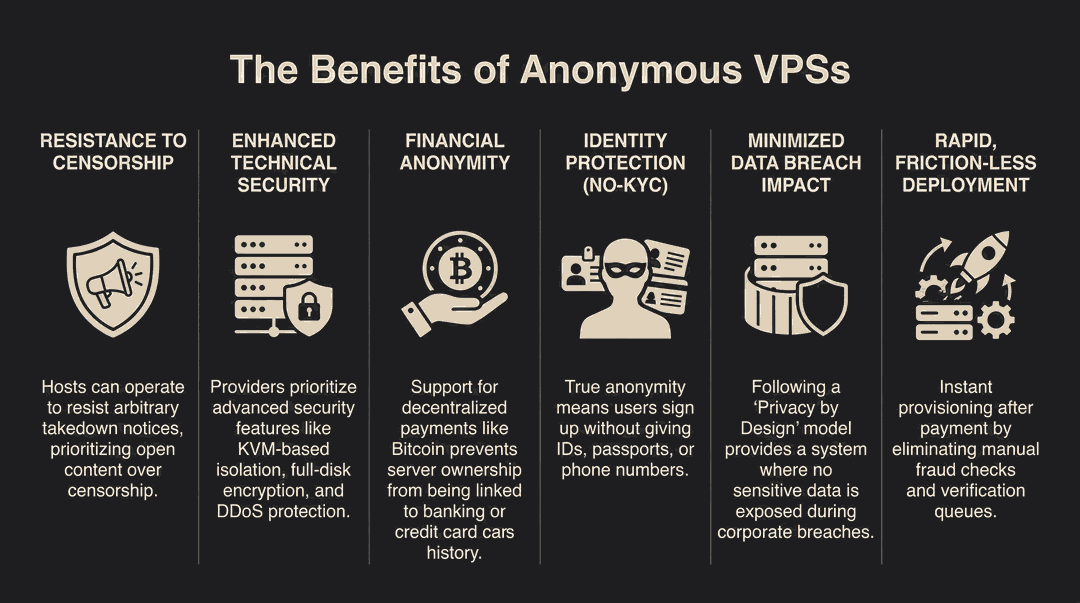
Private VPS hosting provides numerous benefits across not just privacy, but also security and digital sovereignty:
- Censorship Resistance: Many privacy hosts refuse to comply with arbitrary takedown notices from foreign jurisdictions that are intended solely to censor.
- Enhanced Technical Security: Leading providers often prioritize advanced security features like KVM-based isolation, disk encryption, and stateful DDoS protection as part of their standard configuration.
- Financial Anonymity: By supporting decentralized payment methods like Bitcoin, privacy VPSs ensure that server ownership is never linked to a user's legacy banking data or credit card history.
- Identity Protection (No-KYC): Truly private providers do not require "Know Your Customer" verification, meaning users can sign up without providing passports, government IDs, or phone numbers.
- Minimized Data Breach Impact: Because true private VPS providers follow a "Privacy by Design" model and collect no personally identifiable information (PII), there's no sensitive data to be exposed in the event of a corporate security breach.
- Rapid, friction-less Deployment: By eliminating the manual fraud checks and verification queues common with traditional hosts, users can deploy high-performance instances instantly.
The best VPSs for privacy
The VPS providers below all market themselves as anonymous or private VPS providers. Truthfully, though, "anonymous" is a nebulous term that can refer to anything from collecting no information and running no trackers to doing neither. Additionally, many providers promise "dedicated resources"yet oversell their servers, creating a "noisy neighbor" effect that results in poor performance at peak times.
As a result of this variance, we've split the providers below into three categories: "best", "use with caution", and "not recommended". We think it's important to point out which providers aren't worth using, as well as those that are — this will help ensure that you don't take a chance on a provider based on a lack of information.
In our opinion, the golden trifecta is a privacy VPS provider that delivers privacy, performance, and quality support.
The 5 best private VPS providers
After assessing over a dozen privacy-focused VPS providers, five stood out as having good or adequate privacy, hardware/network quality, support, and user sentiment. While we can't guarantee you'll have a great experience with every host on this list, they're the ones we're most confident will offer strong-to-acceptable privacy without major red flags.
1 - BitLaunch

Review score 14 / 15
Founded in 2017, BitLaunch is the standout privacy-first VPS provider on this list — and, in our opinion, the benchmark against which others should be measured. BitLaunch's core philosophy is that privacy requires action, not just promises, and the product reflects that.
Privacy
BitLaunch is excellent from a privacy perspective. It only requires an email address and a password for sign-up, and the email can be temporary. Once logged in, users aren't prompted to enter any KYC and top up their balance exclusively with cryptocurrency, which is handled via BitLaunch's in-house cryptocurrency system rather than by a third party.
BitLaunch only collects the information necessary to provide its service and deletes it as soon as it's no longer needed. It doesn't run any trackers on its site, and clearly states "we don't share [your data] with anybody else". Additionally, users can delete both their servers, accounts, and data at any point via their control panel, no questions asked.
Hardware and network
BitLaunch operates its own first-party infrastructure with Dell hardware including Intel Xeon Gold CPUs and Samsung enterprise SSDs with hardware RAID. It uses ECC memory under KVM virtualization and explicitly states that it does not oversell its hypervisors.
For users who need a wider geographic footprint, BitLaunch also serves as a privacy-preserving front-end for DigitalOcean, Vultr, and Linode. This provides access to 27+ data center locations globally — all payable in crypto through a single dashboard. It's worth noting that while BitLaunch protects your identity from these partners, the partners' acceptable use policies still apply.
Free, stateful, and high-capacity DDoS protection is included free on BitLaunch's own servers, though you may have to pay extra for it on some third-party hosts. Network performance benchmarks well: independent tests put it at an A+ global rating on Bitcatcha, with TTFB comfortably under Google's 800ms threshold. A traceroute reveals the use of high-quality ASNs with no packet loss, low latency, and efficient routing.
Support and developer features
BitLaunch has an around-the-clock expert live chat for support where you can even get in touch with developers who actively work on the product. Response times are fast (usually <5 mins), and agents are friendly and knowledgeable. There's also a blog with comprehensive guides on a wide variety of use cases, from setting up WordPress to hosting your own Bitcoin node.
Finally, BitLaunch is one of the few privacy VPS providers that has an API, and the only one we could see that has both an API and a CLI.
User sentiment
User and media sentiment surrounding BitLaunch is good. A TechRadar review noted excellent support, perfect performance, and a great support team, criticizing it primarily for not offering shared hosting and not having a knowledge base, the latter of which has since been addressed.
Users on Trustpilot, HostAdvice, G2, and BitTrust, as well as other review blogs, note the same positives. The main concern in user sentiment is the 3/5 Trustpilot score. Digging into the actual content of reviews, however, the one-star reviews appear to be from users who are angry their account was suspended and their balance was not refunded when they broke ToS. BitLaunch has been clear that it does not tolerate abuse on its platform and that the balance added to an account is considered final due to the nature of cryptocurrency transactions.
2 - Servers Guru
Review score 12 / 15
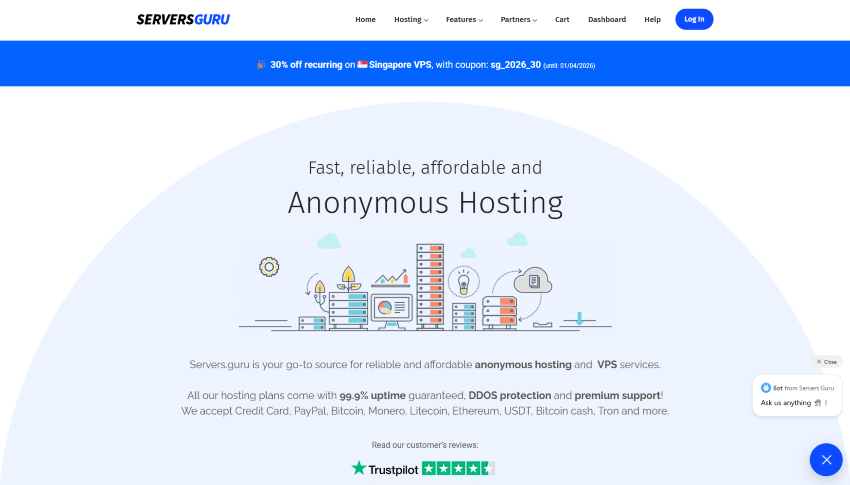
Severs Guru is a relatively new VPS, web hosting, and dedicated server provider founded in 2021 by Moula World LLC. It appears to primarily resell VPS servers from budget host Hetzner. We couldn't find much else about the company online, other than it appears to be based out of a virtual office address in New Mexico.
Privacy
Servers Guru's sign-up process is excellent from a KYC perspective, only requiring an email address, which can be a temporary one. It doesn't get much better than that.
From a wider privacy perspective, though, we found it to good but not great. The site does run some third-party trackers, including stats.wp.com, trackers from its cryptocurrency payment provider, and hcaptcha. These are easy enough to avoid with a plugin like uBlock or Privacy Badger. Moula claims it "won't send or sell your data anywhere or to anyone" and that you can see and edit this info at any time.
Hardware and network
Servers Guru has good hardware, but it's not bleeding edge. While they would not tell us whether they use hardware of software RAID, their servers use enterprise CPUs such as Intel Xeons and NVMe drives.
Our network tests revealed use of mostly "budget" transit providers. An intercontinental traceroute from the US to Europe relied almost exclusively on Hurricaine Electric (HE). Canada to Europe used Cogent. HE and Cogent are some of the cheapest transits a host can buy, and Servers Guru appears to be saving money by not using a premium mix of carriers that would dynamically choose the absolute best path. That said, latency was still good enough — the compromise here is likely to be in consistency and stability rather than straight speed.
One other downside on the networking side was its DDoS protection, which is limited to the US and Netherlands regions.
Support and developer features
When it comes to customer support, the company has a live chat via its website, telegram, or signal, as well as a ticket system. In our testing, a live chat response took around twenty minutes — not the instant response you might hope for, but significantly faster than most email/ticket systems.
Support was generally helpful but cagey when asked about their exact hardware specs before the agent ultimately admitted they assumed the servers used ECC RAM but they weren't sure, and could not provide details on hardware/software RAID. We ask such questions to help determine whether support is operated by experts, and in this case we assume not.
Servers Guru has good support for developers due its API for managing servers. This is a relatively uncommon offering in our experience and particularly useful with recent developments to AI agents.
User sentiment surrounding Servers Guru
Servers Guru's main reviews come from Trustpilot. There are no meaningful reviews from media outlets, blogs, or on forums, perhaps because they are so new. That said, it's Trustpilot score is great — unusually so for a VPS host. It has a breakdown of It's 94% five-star, 3% three-star, and 3% one-star. The single three-star review mentions an issue where a user lost data on their server during an IP change. Support were unable to resolve the issue and had to rebuild the server, only to find that the backup was corrupt. The company responded, refunded the balance, prompting the user to change their review from 1 star to 3.
The one-star review seems to be a standard ToS enforcement case where servers.guru claims the user was banned for hosting leaked adult content. Nothing to read into there other than that Servers Guru is not "bulletproof hosting", which is clearly stated on its website.
Ultimately, Servers Guru appears to be a trustworthy host with decent privacy-practices, decent hardware, budget networking, and good (if not expert) support.
3 - Vsys
Review score 13 / 15
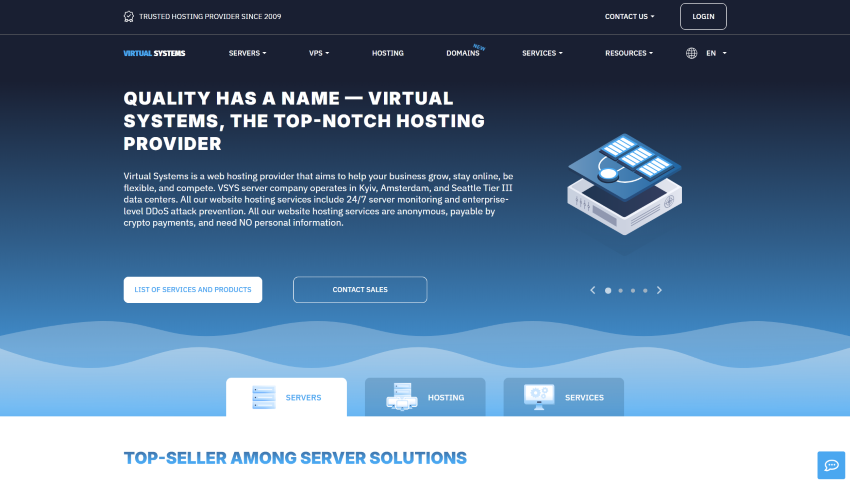
Founded in Ukraine in 2008, Vsys is a web host, domain registrar, and VPS provider that markets itself as having "100% privacy". We believe its privacy is "good enough" while maintaining good enterprise hardware and helpful support. The main caveat is its DMCA-ignored policy, which has already led to a fine being issued by US authorities.
Privacy
Vsys requires you to place an order to create an account, which is a bit strange, but it only asks for a first name, email, and password. We'd rather that first one wasn't in there, but it's still less identifying information than your standard host. Users can then either pay with card/paypal, where they'll have to confirm their full name and address, or pay with crypto, which does not require additional information.
Though it claims "100% privacy" Vsys collects a lot of information about its customers. According to its privacy policy, this includes IP addresses, browser type, ISP, enter and exit pages, operating system, where users click, and more. Worse, it states that this information may be shared with third party vendors and service providers.
While this is common across many internet services, claiming total privacy while running invasive tracking definitely rubs us up the wrong way. Ultimately, users should use Tor or a VPN combined with tracker blocker extensions when interacting with Vsys, which is good practice anyway.
Hardware and network
Vsys uses decent enterprise hardware: its regular servers use Intel Xeon gold CPUs with SSDs and ECC memory, while users can pay extra for AMD EPYC and NVMe drives. A decent balance of quality and performance in our opinion. Unfortunately, RAID storage is limited to dedicated servers, though the company does at least offer two backups per week for free.
On the networking side, it relies on a Tier 1 network backbone with good routing, low ping, and low jitter. However, download speeds are limited to just 200 Mbps on their standard VPS servers, which is quite low.
Support and developer support
Vsys doesn't have a developer API or CLI, but its 24/7 live chat support was also good in our brief exposure to it. They responded within minutes and gave us the information we asked for promptly with no fuss. The company also offers phone number and email support.
User sentiment
Vsys has fifty Trustpilot reviews with an almost 50/50 split between 1-star and 5-star reviews. While that looks alarming at first sight, the context of the reviews are important. Many of the 1-star reviews appear to come from rights holders who are upset that Vsys has not responded to their DMCA requests. Not a practice we agree with, but Vsys does specifically market itself as "DMCA ignored", so it will come as no surprise to customers and may even be a positive for some.
Genuine positive and negative reviews across Truspilot and LowEndTalk paint a picture of a host that largely delivers on its privacy promises and has good support, but may oversell hardware and network capacity, leading to some slowdowns and instability.
One specific incident revealed through reviews is worth mentioning. A customer and Vsys confirm that in February 2026, a US datacenter cut off their connection with no prior warning. It's unclear why exactly why this happened or if there's a risk of it happening again.
Overall, Vsys looks like a decent choice for casual use. Suspected overselling, potential datacenter issues, and the fact that a large portion of its servers are in war-torn Ukraine make it a poor choice for users who require high-uptime or are using it for business.
4 - Njalla
Review score 8 / 15
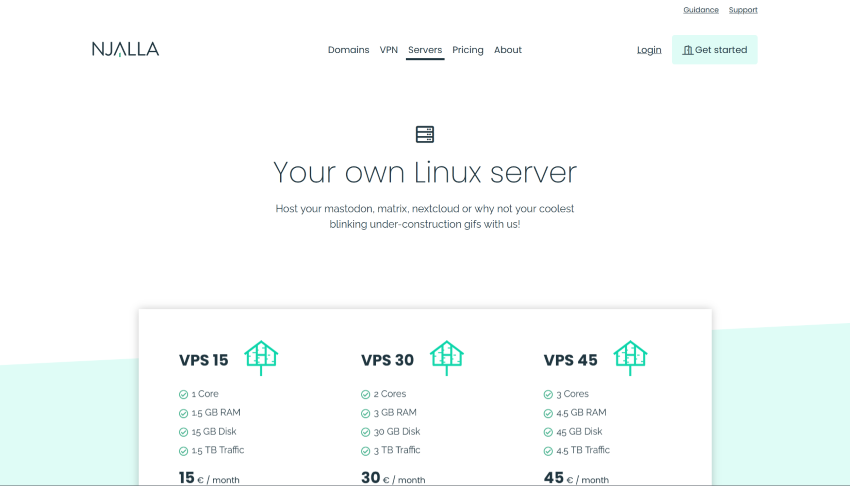
Njalla ranks highly on this list purely because of its privacy chops. Established by Pirate Bay co-founder Peter Sunde, it's an expensive option but comes attached to a strong history of privacy advocacy.
Privacy
Njalla requires a username, email, and password for sign up, only accepts cryptocurrency payments, and does not run trackers or collect user data. More importantly, however, it has fought for its users in court several times to preserve their anonymity. Its terms of service state:
"Njalla will, and has the right to, collect data from you that is necessary for the provision of the Services in the form of email and/or XMPP addresses and the password(s) you set. Njalla will not collect other data about you, other than the above-mentioned data and other such data which is provided by you to Njalla."
One caveat is that Njalla, as a Swedish company, will comply with law enforcement if they have a legitimate case. This is more or less standard for any VPS provider. Private does not mean free from consequence.
Hardware and network
When it comes to hardware, Njalla ranges from mediocre to poor. It uses Incus containers for virtualization, meaning resources are shared. Users report issues with applications such as MySQL as a result of the virtualization method.
On the networking side, it only has servers in Sweden and no DDoS protection.
Support and developer features
Support is quite slow, with an eight hour response time in our testing that provided minimal information. There was no developer API or other dev features available as far as we could see.
User sentiment surrounding Njalla
At first glance, the public sentiment around Njalla is concerning — it has a 1.7/5 rating on Trustpilot and complaints in discussions on LowEndTalk and KYCnot.me. Looking into the context of these reviews, however, they primarily center around Njalla's domain registration service — specifically users losing their domain when their account is suspended due to ToS.
This is more of an issue with the way Njalla's domain service has to work structurally, in our opinion. Since Njalla buys the domain on your behalf, you never actually "own" it; this is what allows you to maintain your privacy. Could Njalla work out some kind of system to transfer the domains of suspended accounts? Probably. But why would it go to so much effort to protect the assets of ToS breakers who never had a legal claim to the domain?
Reviews of Njalla's VPS service, while sparse, aren't exactly glowing either. In particular, the fact it does not use KVM containers appears to cause compatibility issues, while the value proposition is low and support is slow. On the other side of the coin, several long-term users report that they have been using Njalla for some time and are very happy with the service. They praise its privacy, decent network architecture, and lack of any incidents.
Ultimately, you choose Njalla if you're willing to sacrifice good hardware and support for its privacy reputation.
5 - Navicosoft

Review score 11 / 15
Navicosoft was founded in 2008 and has its HQ in Pakistan (Lahore), with offices in Australia (Melbourne), UK (London), and UAE. In our opinion, it's not really a private VPS provider; more a traditional web host that added "anonymous VPS" for SEO because it supports cryptocurrency. However, if you're willing to give up some privacy in return for more traditional web host services such as ICANN-accredited domain registration, there's some value here.
Privacy
Navicosoft asks for your full name, address, and phone number on account sign-up, but it's important to note that you can skip this as the form field is not marked as mandatory. The caveat is that its ToS says users must "provide the right information that is full and complete during the registration process". So, just be aware that this could be used against you in the future.
The host supports several major cryptocurrencies, but it hasn't put effort into ensuring users cannot be tracked while doing so. In fact, its basket states that your IP address is being logged to prevent fraud as you make the purchase. Its privacy policy is no better; Navicosoft logs you IP, uses aggregated data for marketing purposes, and notes that they may require "additional forms of identity" for refunds and other services. We counted several trackers on the site, including Google Analytics and Tawk.to, which claims to allow businesses to "See which pages your visitors are on in real time, what they are searching for within your Knowledge Base and how often they visit your website".
Hardware and network
Navicosoft uses standard enterprise hardware for its VPS servers: EPYC or Xeon depending on the VPS chosen. Support told us that some server configurations support ECC RAM and some don't, but since this isn't listed on each config page, whether you get it or not could be a lottery. That said, it uses exclusively NVME drives and KVM virtualization. Support were not able to tell us if their NVMes use hardware of software RAID; it's more likely to be the latter.
The company has a network test tool at very top of their VPS page, so networking is clearly something it's quite proud of. We did indeed find latency to be fantastic in our tests. Navicosoft uses premium infrastructure with ECMP routing for the best speeds to and from your destination. You'll also get free DDoS protection with your server to prevent disruption via external attacks.
Last but not least, Navicosoft allows you to rent VPS servers in a huge 100+ countries. This is far more than most privacy VPS providers, and there's even support for lesser-seen regions such as Eastern Europe, Africa, and South America.
Support and developer features
Navicosoft's 24/7 support was good in our experience. They responded within seconds via live chat and gave us the information we requested with no fuss. As well as live chat, they have phone support, a ticket system, and email support — so all bases covered there.
Support for developers is lacking; the focus here is on tools for less technical users, such as cPanel and managed hosting. As such, we couldn't see a developer CLI or API.
User sentiment
Navicosoft has positive reviews and seems to be a genuinely decent host, but its user sentiment also makes it clear that privacy-oriented users really aren't its main target audience. The reviews indicate that it's primarily used by small businesses in Australia, South Asia, and Africa for its marketing services and web hosting.
Sentiment surrounding its VPS service specifically is very polarized. While there are a dozen positive reviews praising performance, stability, and support, many read like customer case studies and have a solicited feel. This isn't helped by the company's lengthy, keyword-stuffed replies. Negative reviews, meanwhile, are scathing. They talk of multi-day deployment times, slow network speeds, and deployments with the wrong configuration or region.
Private VPSs you should use with caution
Providers in this section are ones that we consider to have some combination of misleading marketing, questionable privacy practices, shady corporate structures, strong links to malicious activity, or poor support. We're not confident enough in our assessment to say that nobody should use them, but there are certainly better options.
Nice VPS
Review score 10 / 15
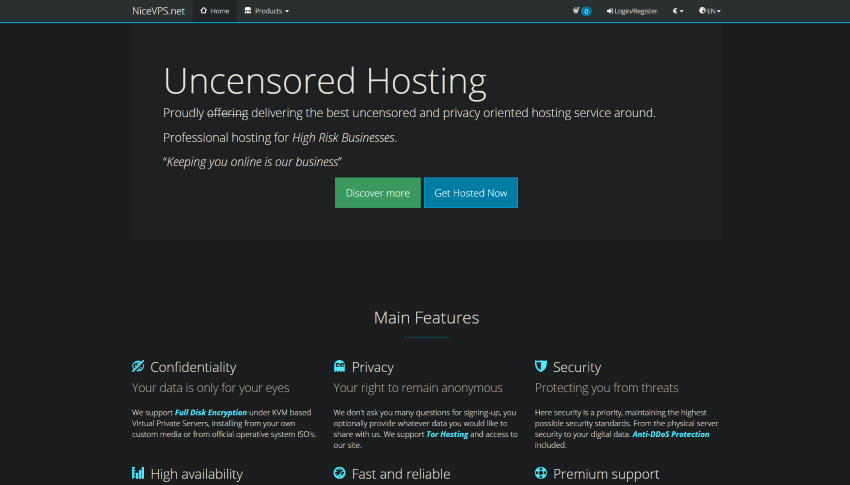
While its website is very basic, NiceVPS, founded in 2017, has a "nice" combination of privacy, hardware, and features. It claims to privately own all of its hardware and network equipment and supports Tor hosting.
Privacy
NiceVPS doesn't require any KYC on sign-up, only requiring a username, email, and password, with temp mail allowed. It also supports crypto exclusively, which we always like to see. While it doesn't have a dedicated privacy policy, its terms of service seem to suggest that it runs no trackers on its site and our tests confirmed this. It only keeps a cookie to store the log in session.
Hardware and network
NiceVPS does not share in-depth hardware specifications for its servers and its support unfortunately ignored our ticket about it and closed it when we asked for the information. What we can tell you is that they use LXC virtualization by default, with the ability to upgrade to KVM for an extra fee. They also allow you to choose between NVMe or SSD storage and support nested virtualization.
In terms of network, the locations on offer are very limited — just the Netherlands. While this location does have the advantage of 10 gbps network speeds and included DDoS protection, we weren't able to perform an mtr test without renting a server. Since you have to pay for at least three months at once, this was outside of the scope of this article.
Support and developer features
NiceVPS would be higher on this list were it not for its baffling support practices. Its ticketing system contains warnings such as:
"Read everything before opening a ticket, do NOT request information that is clearly visible: You'll be ignored. Failing to comply with any of the above conditions may lead to: Remote work billed at a rate of €180.-/hour (minimum of 10 min.) Support tickets disabled Complete account suspension / ban."
This is an absolutely ludicrous policy that some would consider exploitative and hostile. Our experience with support was unfortunately non-existent. Asking simple questions about their server hardware quickly led to the ticket being closed with no answer. Not trying to convert users into paying customers by answering their sales questions is quite frankly baffling, and user reviews of their support suggest you probably won't get much help with technical issues, either.
NiceVPS user sentiment
There aren't many reviews for NiceVPS because it lacks a Trustpilot profile. The low sample size makes it difficult to make an accurate assessment of what users think as a whole, but the sentiment that exists is poor. Users report issues with stability, support demanding additional payment to deal with abuse reports or set up issues, and bans for asking for help. It's worth noting that some of these seem to be from users breaking ToS.
We found a few positive reviews from 2018 that contradicted some of these complaints, with statements such as "their support is very helpful and fast replying to any queries you may have".
Overall, the combination of poor reviews of support and their own stated support policies muddy an otherwise privacy-positive VPS provider. We must warn users to exercise caution, deposit small amounts of crypto, and be ready to resolve technical issues personally.
Cloudzy

Review score 13 / 15
Cloudzy is a VPS company that has been around since 2008 under its former name, RouterHosting. It's characterized by cheap pricing and flexible payment plans, but allegations of widespread malicious use of its servers, combined with its unclear country of origin (more on that later) make us hesitant to fully recommend it.
Privacy
Cloudzy asks for a full name on sign-up or allows users to sign in using socials, neither of which are very privacy-oriented. It also blocks the use of temporary email addresses. That said, Cloudzy at least does not require ID or credit card information.
Unfortunately, its privacy policy reveals that it runs trackers on its site from embedded content. This is no surprise, since the social logins we mentioned earlier tend to come with trackers that follow you across sites. Concerningly, Cloudzy does not list which third parties track users and nor could their support provide us that information.
For payment, Cloudzy supports a variety of crypto. It also allows users to pay with card via Stripe or via AliPay, which naturally comes with privacy consequences.
Hardware and network
Cloudzy offers good hardware, with AMD EPYC enterprise CPUs, DDR5 RAM, and NVMe drives. It also offers GPU servers with RTX 5090s, which is very useful if you're planning to train AI models.
The company appears to use high-quality bandwidth providers and logical routing. Our traceroute suggests use of Tier 1 bandwidth providers and direct to ISP routing, with overall low ping. That said, one quirk is Cloudzy's DDoS protection, which was marked as "out of stock".
Customer support and developer features
Cloudzy only offers a ticket system for support, which is a bit disappointing — we'd prefer a live chat or phone number for emergency situations. That said, ticket support times were reasonable, usually receiving a response within two hours during working hours, and sometimes within minutes. We did not receive a response outside of working hours despite claims of 24/7 support.
The quality of support was good, but a bit cagey when it came to hardware specifics. Our support agent told us they would get in contact with their technical teams, which suggests the agents are non-experts.
The provider also has a developer API that allows users to programmatically check on, create, and scale instances.
User sentiment
Cloudzy has an unusually high Trustpilot rating of 4.5/5, with widespread praise for its support, budget pricing, and stability. 72% of its reviews represent 5-star ratings, 7% four-star, and 17% one-star.
We found some practices that raised questions about its Trustpilot ratings — Cloudzy flagged 24 one-star reviews to Trustpilot as illegitimate, with only a 50% success rate. To be clear, Trustpilot often errs on the side of the customer, so this isn't an indication of wrongdoing, but it does show that the company aggressively manages its reputation. Interestingly, some negative reviews directly contradicted the points in positive ones. Users across Trustpilot and Reddit complained about downtime and stability, poor support response times, and buggy control panels. A couple of users also reported surprise bandwidth bills, though we suspect this may have been caused by servers compromised by a botnet or similar.
A bigger concern, perhaps, is a 2023 report by Halcyon. The cybersecurity company alleges that potentially between 40–60% of the servers hosted by Cloudzy appear to be directly supporting potentially malicious activity, including state-sponsored hacking groups. This is a claim Cloudzy denies, but if true, it could mean issues for legitimate customers, such as IP addresses being blocked and flagged.
Further concern is raised by Halcyon's assessment that, with a high degree of certainty, Cloudzy is a cutout for AbrNOC, a company operating out of Tehran rather than its claimed New York City. It found direct crossover between fake employee lists, the same logo, and the same founder. While this isn't a deal breaker per se, it does raise some questions — most pressingly, what happens to Cloudzy's US customers if it's found to be violating sanctions on Iran?
Regxa
Review score 10 / 15
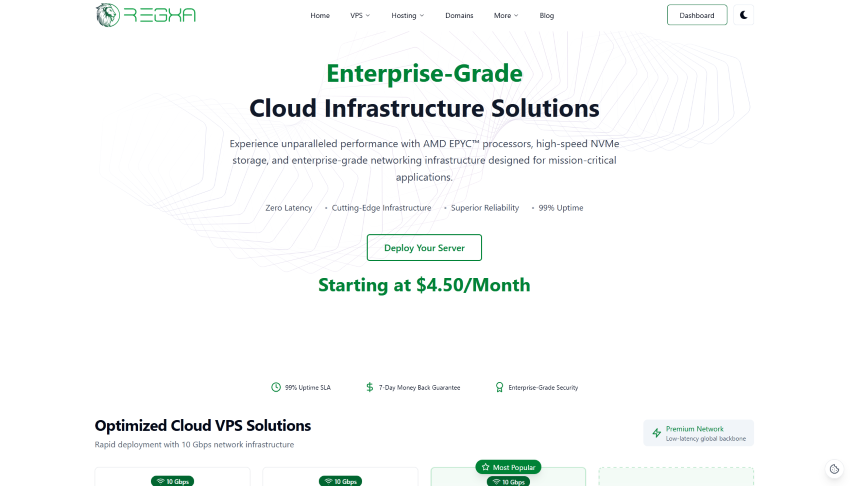
Rexga claims to be a US-based company founded 10+ years ago with 100,000+ customers across 12 data centers. Like a few other hosts on this list, its "anonymous vps" branding appears to be more of a marketing ploy than a real privacy philosophy, and its US status is misleading.
Privacy
While Regxa's website claims "Complete privacy and anonymity for your virtual server with cryptocurrency payment options", it requires a name and address for sign-up. It also collects plenty of data on its users despite claiming a "no logs" policy. This includes service configuration and usage data, IPs, performance metrics, usage stats, browser/device info, server logs and monitoring data.
The company shares this information with third parties to aid in its operations and to "protect our rights, privacy, safety or property", which is a little vague for our liking. It also retains information for as long as necessary to provide its service and comply with legal obligations. In other words, it's another "anonymous vps" provider that's anything but.
Hardware and network
Regxa uses good hardware on its Cloud VPSs — EPYC CPUs and NVMe drives in RAID configuration. However, it's worth noting that users report very high steal time (50-80%), as well as performance issues and crashing. This is likely exacerbated by the fact that it does not use ECC memory, which allows providers to offer lower prices, but does affect stability.
Our network tests showed good ping, but we weren't able to determine the transit providers, suggesting they're either using MPLS or the transit providers are specifically configured to hide their routers from traceroutes. Interestingly, it terminated in an OVHCloud address, and other analysis suggests it may be primarily reselling OVH hardware. This may leave it with limited control over the infrastructure it sells. The provider promises 10gbps down/up and unlimited transfer, but reviews suggest speeds around 800 mbit are more common.
Support
We had mixed response times with Regxa's support — sometimes receiving a reply in an hour, and others within 15 minutes. The company appears to use a bot as an intermediary to gather information while waiting for an agent, which gives the impression you're going to receive a reply soon when you could still be waiting for a while.
User sentiment and analysis
Our analysis suggests that Regxa LLC is dressed up to look more western than it is, potentially for payment processing or accountability reasons, but possibly to make the company feel more "legitimate". It was only registered under BBB in the US in 2025 under a virtual office address and is yet to be BBB-accredited. We also found a UK shell, Regxa LTD, incorporated in 2020, with no accounts filed prior to its dissolution in 2022. Its company profile on ZoomInfo lists its corporate headquarters as Ankara, Turkey, while its ASN (AS215311) is linked to an entity registered in Iraq/Kurdistan.
None of this is necessarily malicious, but it's arguably deceptive to list its US arm as the address on its webpage. We were also unable to source its claim of 10+ years of excellence — its own website and domain name records say it was founded in 2018.
While Regxa's website rates it 4.5/5, Regxa's Truspilot rating is a much less impressive 2.4/5 stars across 81 reviews, with a 64% 1-star rate. It's worth noting that a significant portion of these reviews are from users who believe Regxa's promise of "DMCA-ignored" hosting is false. Its ToS clearly states that DMCA behavior is governed by the server's jurisdiction, the claiming party's jurisdiction, and international agreements.
Other negative reviews point to issues prevalent with budget VPS hosts — potential overselling, billing issues, and random price increases. Some users also note slow support during outages, a lack of IPv4 addresses in certain regions, and credit-only refunds for cryptocurrency despite the company's "14-day money back guarantee". Non-generic positive reviews mention mostly stable performance over longer periods, lack of KYC, and cheap domain registration.
Privacy VPSs we can't recommend
There are several VPS providers marketed as private or anonymous VPS that we just can't recommend. They come with significant scam warnings, aggressive KYC, shady practices, or non-existent support. While we'll keep our assessment here to document these concerns, you use them at your own risk.
MonoVM

Review score 11 / 15
MonoVM is a long-standing VPS and hosting provider with a mature product ecosystem covering VPS, dedicated servers, web hosting, and domain registration. Like several others on this list, however, its "anonymous" branding appears to be more of a marketing play than a genuine operational philosophy.
Privacy
MonoVM's sign-up process is poor from a privacy perspective. It requires a full name and address on account creation, though temporary email addresses are permitted. Cryptocurrency is supported and does not require additional KYC, such as an ID, if you manually transfer rather than using one of their third-party payment services.
What's immediately striking is that MonoVM doesn't appear to have a standalone privacy policy at all. The URL labelled "Privacy Policy" on their site resolves to their Terms & Conditions document with no dedicated section on data collection, retention periods, or third-party sharing. The cookie policy fills in some of the gaps, but not reassuringly. MonoVM explicitly deploys targeting and advertising cookies, web beacons, pixel trackers, and log files alongside the usual analytics and performance cookies — a surprisingly invasive stack for a host marketing itself as privacy-conscious. Third-party cookies from external technology partners are also acknowledged, though the policy doesn't name them.
What the ToS reveals is no better. Refund requests trigger a KYC verification process that requires submission of identity documents via a ticket — meaning a full anonymity failure at the point of any financial dispute. The ToS also reserves the right to monitor duplicate accounts and suspend services at its discretion with minimal notice.
Taken together, the absence of a real privacy policy, active advertising trackers, and KYC-on-refund make MonoVM a poor fit for anyone with genuine anonymity requirements.
Hardware and network
MonoVM's infrastructure is good. Servers run on Intel Xeon or AMD EPYC with NVMe SSD storage, ECC RAM, and hardware RAID 10. Network connectivity runs on 1 Gbps and 10 Gbps dedicated ports with a claimed 99.9% uptime SLA. The company peers with multiple Tier 1 and Tier 2 providers with diverse upstreams per region, which is reassuring for routing quality and resilience. The provider declined to name specific transit partners without knowing the target datacenter or IP, which is a reasonable if slightly evasive answer.
Asks for name, address, on sign up. temp mail allowed. Can pay with crypo without additional KYC as long as you choose cryptomus but make the transfer manually.
Support and developer features
MonoVM offers a standard support stack — live chat, ticketing, and email — with a Canadian phone number listed. We didn't find a developer API or CLI in our assessment, which is a gap for technically oriented users who want to programmatically manage infrastructure, and a contrast to providers like Servers.guru or Cloudzy that do offer one
User sentiment
MonoVM's Trustpilot score is poor — 2.2 out of 5 from 66 reviews, with a stark polarisation: 47% five-star and 45% one-star, with almost nothing in between. One reviewer explicitly flagged this pattern as suspicious, suggesting the glowing reviews may be artificial while the one-stars reflect genuine user experiences. It's worth noting that MonoVM advertises a 4.5 Trustpilot score on its own homepage, which appears to reference an older or different dataset and is at minimum misleading.
The recurring complaints in negative reviews are consistent and specific: support ghosting users on billing disputes, servers terminated without adequate notice, payment processing issues through third-party gateway IYZICO, and advertised "unlimited" bandwidth that turns out to be capped at 12 TB. Several users also report being required to submit identity documents to get a refund — consistent with the KYC-on-refund clause buried in the ToS. There are also reports of cryptocurrency users having refunds denied or delayed, with regulatory compliance cited as the reason.
Positive reviews, where credible, tend to focus on server performance and speed rather than support quality.
MangoHost
Review score 12 / 15
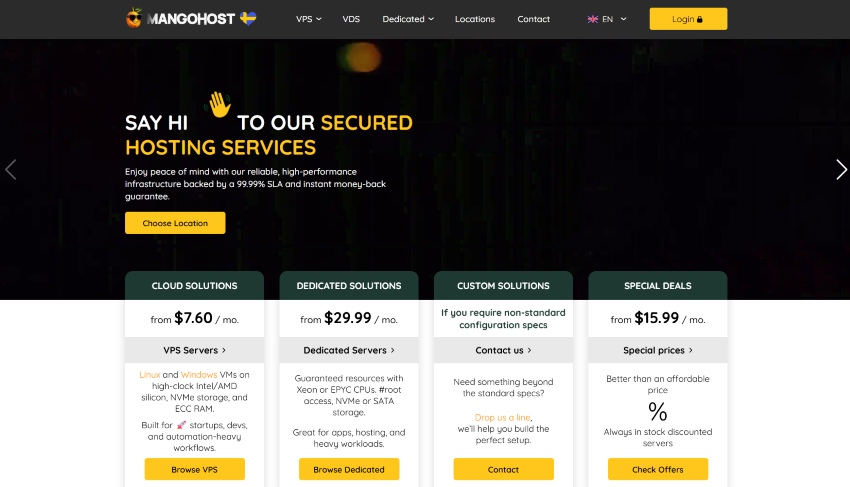
Based in Romania and Moldova, MangoHost has been around for over ten years and offers a mature ecosystem of VPS, VDS, dedicated, and cloud servers. Our overall impression is that, despite its anonymous branding, it's more of a traditional host that supports crypto than a service focused specifically on privacy.
Privacy
MangoHost requires KYC on sign up, including your full name, address and phone number. There does not appear to be a way to bypass this even if you intend to only pay with cryptocurrency.
Its website also runs several privacy-invasive trackers that collect information such as IP addresses, browser fingerprint, operating system, and ISPs. This information is not just used for its own purposes — it's shared with affiliates and third-parties.
In other words, the company doesn't just fail to cater to privacy enthusiasts. It makes an active effort to erode your privacy and will happily share the data it collects with others.
Hardware and network
While its privacy is a wash, MangoHost at least has decent enterprise hardware. It uses KVM virtualization, AMD EPYC processors, ECC memory and fast, Samsung NVMe SSDs. Interestingly, it allows you to configure your server to your liking, adjusting the amount of RAM, storage, and vCPUs to meet your requirements. It specifically states that it does not oversell, which we always like to see.
The networking is on the more budget side. The host uses transit from Voxility, which is good, but also seemingly Cogent, with is less so. Regardless, Voxility-powered servers have fast routing, low latency, and free DDoS protection.
Support and developer features
MangoHost offers support via livechat, email, and phone. Their livechat 24/7 support was excellent in our experience. They responded instantly and told us exactly what we needed to know despite there being some quite technical questions.
However, it's live chat appears to be primarily for sales and is a bit pushy, sending a generic "How can I assist you" message when you visit the page to try to convert you to a paying customer. Technical support is handled via ticket instead, which is a little slower but still very reasonable.
User sentiment
MangoHost has a pretty thin review footprint despite its 10+ years of operation. Just 7 reviews on Trustpilot, six 5-star, one 1-star. Most of the positive reviews read as genuine to us. Long-term customers praise their support, low latency, and network reliability, but do note that the download speeds cap out at around 650 mbit.
The single negative review somewhat is concerning. It alleges that MangoHost tried to upcharge the user from $85 to $500 to cover costs of DMCA notices, then tried to negotiate with the user to leave backlinks from their websites to MangoHost's site instead. Interestingly, the host does not deny this; they simply say:
"Hello, we do not charge you $500. We said that next month our service will cost you $500. You refused and thats it. It was hard to communicate with you."
Hosting101.ru — a Russian hsoting review aggregator — has a much higher volume of reviews for MangoHost. Notably, there are several long-term reviews. One user says they have been running their VPS for 600+ days with no reboots or network issues, which backs up the stability mentioned in Trustpilot reviews. The other, from a customer in 2016 who used them for 2+ years, suggests that the host started to go downhill at the time of writing, with support failing to respond to their tickets after an IP was blocked at the DC level.
VPS server
Review score 7 / 15
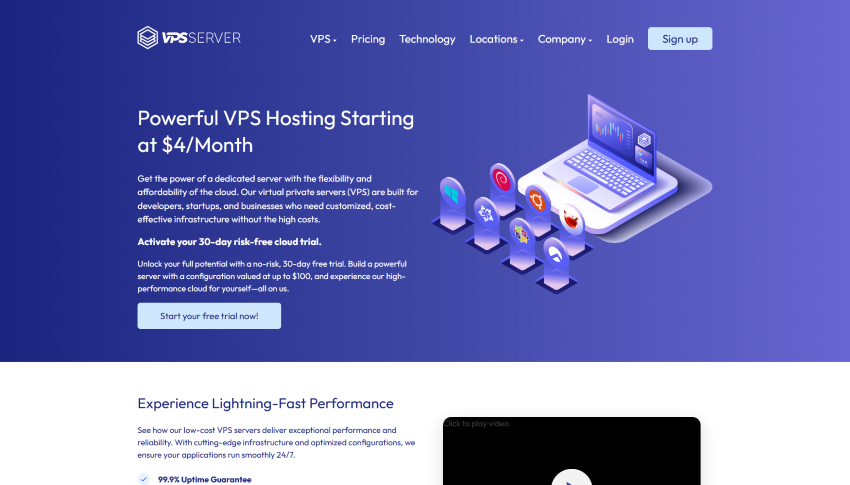
VPS Server is a long-time VPS host that was acquired by Kamatera Inc. in 2023. Like many, it claims to be the "best VPS anonymous provider". Its marketing material is quite vague on why exactly that is. It uses phrasing such as "Our anonymous hosting solutions ensure that your personal information and activities are shielded from prying eyes".
This is likely because, as far as we could tell, VPS server does next to nothing to protect users' privacy.
Privacy
VPS server only requires and email and password for sign up, which is positive even if temporary emails are blocked. Unfortunately, that's where the good start ends. As soon as you log into your account for the first time VPS server asks you for billing information, including your full name, address, and phone number. Adding insult to injury, the company does not accept cryptocurrency payments. Fiat cash only here. You're prompted to enter your card details after account creation to confirm your information via a $2 transaction.
It doesn't stop there. The company logs and tracks users extensively, using Google Analytics, hidden Facebook pixels, and an AI fraud-prevention tool called Riskified. Together, these collect information such as the pages you click on, the buttons you interact with, your IP address, your browser fingerprint, operating system, location, and time zone. It's AI chat also collects user messages, including server logs that may include sensitive information. All of this data may be stored "at Company’s sole discretion: ... (iv) to protect Company from any potential disputes" — i.e. potentially forever.
VPS Server also uses your information for its third-party marketing and advertising efforts, as well as selling "aggregated or de-anonymized" data to others for "for marketing, advertising, research, or other purposes". This opens the door to them monetizing your behavioral data, and, as we've mentioned previously, numerous studies have shown that even "anonymized" can typically be traced back to real people.
Hardware and network
VPS Server has three tiers of VPS hardware on its servers: Starter, Standard, and Enterprise. They all use KVMs, but the choice between SSD and NVMe storage varies per location. The main difference between the plan, then, is in the CPU. VPS Server says it uses "the latest CPUs, including Intel Xeon". The plan determines the CPU core type, which is an availability core at the lowest tier, followed by a single core, and then a dedicated core.
Since VPSServer has published a YABS benchmark, we were able to compare the performance of its 4GB/2 CPU plan directly against BitLaunch. What we found was concerning. VPSServer's Geekbench score on both single and multi-thread was around half of BitLaunch's. Despite its promise of "unlimited IOPS", its IOPS were around 700 MiB lower than BitLaunch's on average. Given that BitLaunch uses SSD drives and VPSServer claims to use NVMe, this is very odd.
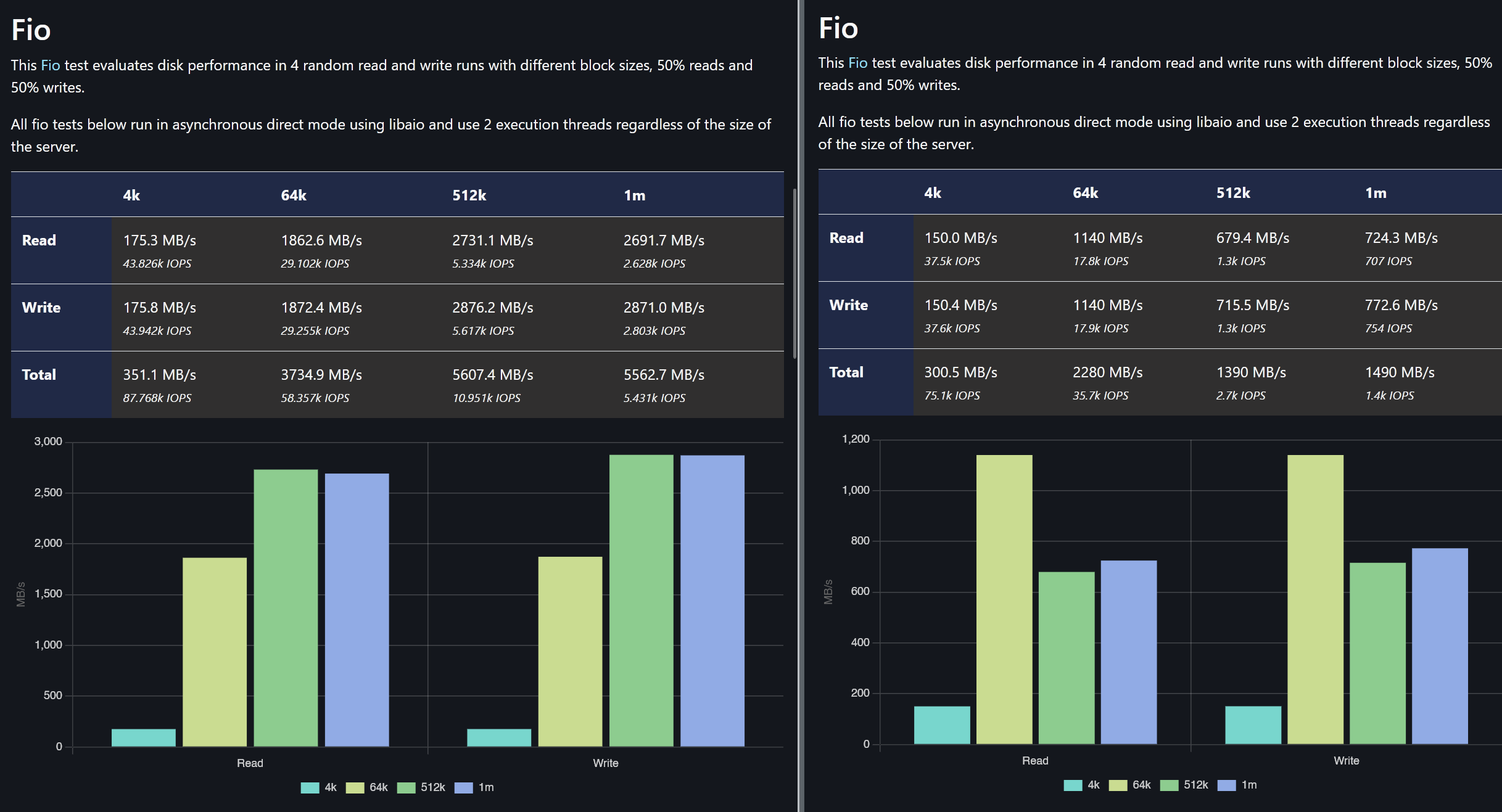
This could be down to numerous things: an over-provisioning of storage resources, a hard cap on IOPs, or VMe drives behind a RAID controller or SAN that bottlenecks the connection. None of these are really good looks for a provider that promises unlimited IOPS.
Download speeds are also lower, though still acceptable speeds for most people. VPS server benches at ~650 mbit down/up, which is good enough for casual use cases. It claims to use maximum throughput with low latency and network redundancy, though we weren't able to independently verify this.
Overall, you can probably get decent hardware outside of the budget plans. According to user reviews, lower-tier servers are shut down if they experience a CPU spike, with users sometimes required to contact support to get them back up and running. If true, that's an extremely frustrating practice that could lead to lost revenue for businesses relying on the servers.
Support
We weren't able to use VPS Server's livechat support since their system refused to accept multiple cards as a billing method, and support does not unlock until you do so. While we did test their contact form, we were unable to get a response before this blog was published.
User sentiment
VPS Server has a rating of just 1.4 stars on Trustpilot, with 47% 1-star reviews and 49% 5-star. A common thread in negative reviews is that VPS Server makes cancelling an account far too difficult, allegedly on purpose. According to one reviewer, removing a card takes 15-days, and if the user forgets to confirm it after that point, they're charged again, even when servers were technically "shut down". Another long-form review suggests a pattern where servers are repeatedly shut down for "excessive CPU usage" as a tactic to upsell users to more expensive tiers, where the pattern continues.
Less concerning but still highly relevant are a cluster of reviews in 2024 that suggest increasing instability and outages, slow speeds, and slow support. At least one user reports unexpectedly needing to verify with a government ID to access their account.
User sentiment suggests that support is slow, rude, non-expert, and likely outsourced. This aligns with our research, which found an Indian phone number listed on the company's ZoomInfo profile despite its claim to be US-based. The actual operations are likely in Kiryat Bialik, Israel, where Kamatera is based.
Unfortunately, positive reviews are largely unspecific, old, or from users who have only used the service for a short time.
AnonVM

Review score 10 / 15
Founded in 2022, AnonVM is a very new host that offers a variety of server types (VPS, dedicated, managed web hosting, etc.) with a privacy-focused slant.
Users on LowEndTalk have identified AnonVM as a downstream provider of pfcloud, receiving ASNs, subnets, and hosting from the German company. This is important because users report pfcloud is home to a lot of malicious activity. Its operator was previously detained due to malicious activity on its hosts and downstreams, leading to significant downtime.
Privacy
AnonVM starts off strong by only requiring a password and email, which can be a temp mail. That said, it does encourage users to sign in with Google, which is not privacy-conscious. In terms of payment, there's crypto, as well as usual fiat options like card and PayPal, which naturally require your full name and address.
Unfortunately, our analysis of its half-finished privacy policy wasn't quite as positive. The company admits to collecting metadata, including browser, operating system, and time of page visit, as soon as users visit the website, as well as using third-party cookies. This includes collecting information to analyze user behavior.
When we reached out to support to ask for clarification around which third-party trackers there are, we received conflicting and incorrect information. AnonVM's support told us that the chat feature was an example of a third-party cookie, but then went on to claim that their privacy policy is "wrong" and they do not store cookies in any way, ask for KYC, or store logs.

While we can't speak to logs, anybody can see that the company does store cookies using the browser's developer mode. We also picked up a number of trackers, including tawk.to, which allows businesses to "see which pages your visitors are on in real time, what they are searching for within your Knowledge Base and how often they visit your website".
Hardware and network
AnonVM uses good hardware — AMD EPYC CPUs with NVMe drives and ECC memory (though that memory is DDR4).
For networking, AnonVM says it primarily uses Skylink Datacenter, which it says is carrier-neutral. It claims to use a mixture of budget and high-quality carriers such as Hurricane Electric, Lumen, Cogent, CentraCom, & Zayo. It also claims direct peering with major ISPs and optimized routes. DDoS protection comes free of charge, while servers have unlimited bandwidth and a shared 10 gbps link. Our tests suggest it primarily uses Cogent. While a large, global ISP, it's considered a budget provider and is more prone to peering disputes and other issues as a result.
Support and developer features
AnonVM offers support via ticket and live chat, which it claims runs 24/7. However, we did find several instances where no support was available via livechat and we had to submit a ticket instead. When agents were available, they replied within minutes, but as previously noted, some of the information given contradicted the literature on their website and common sense. Some reviews also state issues receiving a response from support regarding billing issues.
Unfortunately, the host doesn't offer a developer API or CLI and does not appear to cater specifically to developers.
User sentiment
AnonVM's user reviews are sketchy, to say the least. It has exclusively 1-star and 5-star reviews, with many of its 1-star reviews alleging fake positive reviews. We did see some suspicious signals in its reviews — a large volume of 5-star, single-line reviews by new accounts.
Several negative reviews call the company "scammers" and allege that their servers were never deployed. Other "scam" accusations appear to be from users who had their accounts suspended — it's not clear if these users broke ToS. Reviews on LowEndTalk are also negative. The appeal of AnonVM, then, largely appears to be for malicious actors, who may or may not scammed themselves.
Lightnode
Review score 7 / 15
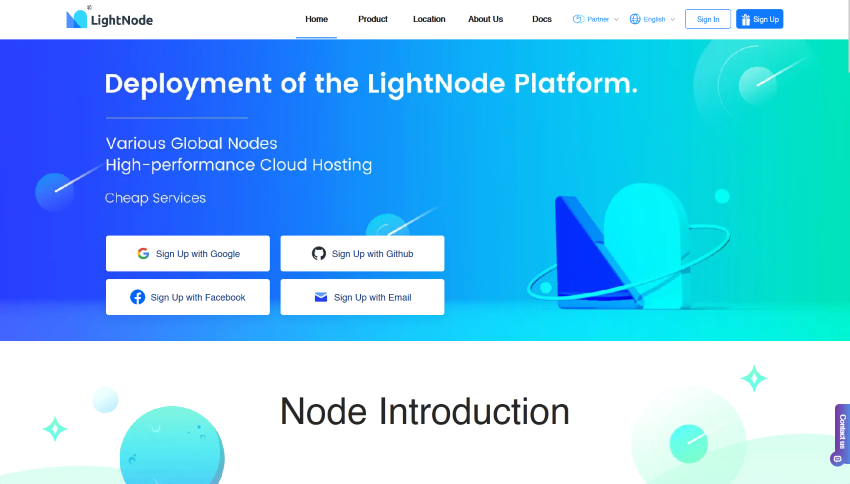
Lightnode is a VPS/Cloud host founded in 2002 that claims to have 500+ employees and "unparalleled privacy". It's one of the few anonymous VPS hosts that offers a developer API, and it claims to be cheaper than both Vultr and Digital Ocean. It also has a variety of exotic locations you won't find from other hosts, such as Mexico, Dubai, and Bangladesh. As you'll gather from its ranking on this list, however, there's more to the story.
Privacy
While you can sign up for Lightnode with just an email, which can be a temporary one, the company then asks for your full name, address, and phone number before you can use your account. Cryptocurrency payments are supported alongside PayPal or card, so we're unsure why this information is mandatory.
On the tracking and logging side, Lightnode's privacy policy raises plenty of red flags. It has Google, Facebook, Matomo and Cloudflare trackers alongside tracking through cookies, invisible images, and other technologies. Accordding to the company it tracks the pages users view, their browser type, IP address, length of time on site, and referring information and combines this with the information it already knows about users. Worse, it shares this information with third parties both for its own promotion and advertising as well as "de-identified" information with third parties for their own advertising and market research.
Hardware and network
Lightnode uses KVM technology with a variety of Epyc and Xeon CPUs paired with NVMe drives. We weren't able to get hold of their support to confirm whether they use ECC memory or RAID.
The provider appears to use Cogent for its networking, which as mentioned previously is a budget tier 1 provider that has previously been referred to as the Dark Lord of telecom. Our network test came back fine with good ping, but one test, of course, does not indicate long-term stability.
Support
Lightnode simply didn't respond to our livechat queries other than spamming several promotional messages. While they do have a phone number, it's a Hong Kong one, and we didn't receive a response over email, either. Ultimately, we struggle to recommend any host that doesn't offer support, since users are left out of luck if their servers experience technical issues.
User sentiment
Lightnode's Trustpilot reviews are poor. It has 58% 1-star reviews, 28% 5-start, and a smattering in between. There is one central theme among the negative reviews — support is functionality non-existent. This tracks with our experience via both livechat and email.
More concerning, several users report the company trying to charge the wrong amount by almost 10x. After some investigation, it appears that this may be a UX problem rather than a genuine scam attempt. The bill is likely in Hong Kong dollars, while the top-up amount is reflected in users' local currency. This however, does nothing to assuage another complaint — that Lightnode shuts down servers with no warning and with no recourse due to their lack of support.
Most of the positive reviews, frankly, do not feel legitimate. They contain short content such as "I'm always excited to see what new features LightNode introduces. Their commitment to innovation keeps them ahead of the curve", "LightNode has streamlined my workflow like no other tool. It integrates seamlessly with my processes, making everything more efficient", and "Working from home has never been easier for me thanks to LightNode. Its reliable connectuion and quik acess are essential for keeping our productivity lelvels high".
A dive into Chinese forum/review content suggests that LightNode is the international brand of a mainland Chinese company, Kaopuyun, which some will find relevant for privacy. A first-hand account by a Chinese developer may reveal why users find their VPS's randomly suspended. According to the dev, LightNode's IPs are heavily used by grey area operators (灰产) and legitimate users often get caught in the crossfire because the shared IP pool is contaminated.
How to choose the best private VPS for you

We've listed the best anonymous VPS providers above in a binary order, but reality is rarely so objective. People seek out privacy VPSs for different reasons and use cases, and this leads to different requirements and standards. The best way to aid your decision is to ask yourself the following questions and use the table above to shortlist providers that meet your needs.
- Is privacy an imperative or a preference? If anonymity is essential to your work or very important to you, you'll want to choose one of the providers marked as 3-stars above. Otherwise, services that ask for some information (such as a first name) may be acceptable.
- How "mission critical" is your VPS use case? If you're hosting a website, trading, etc. then good hardware and networking will be essential. However, if you're just hosting for personal use, you may be able to live with occasional downtime or slowdowns for a lower price.
- How technical are you? Are you comfortable with server operation, or do you need a support team that will have your back for server configuration and support?
- How important are developer tools? Is the ability to programatically provision and pay for servers something that's likely to be useful for you now or in the future? Do you use tools such as OpenClaw that would benefit from API access?
- How important is user sentiment to you? Do you place a lot of value on user reviews, or are you happy to assess a provider for yourself?
- Do you need a "bulletproof" host? This is going to limit your options significantly, since true bulletproof hosts are rare and more likley to be unstable, have poor support, and get their IPs banned.
- Should you buy a privacy VPS at all? If you don't want to pay with cryptocurrency, need specific compliance, want the cheapest servers available, or need a wide range of web hosting services, private VPS hosting probably isn't for you.
Once you've selected your provider, we recommend starting off small. Deposit a small amount of cryptocurrency or pay for a month, even if there are better yearly deals. A good rule of thumb is to only put in as much money as you've already spent. For example, if your provider has monthly, quarterly, and yearly plans, switch to quarterly after a quarter of monthly payments, and to yearly after a year of payments, etc.
Don't be afraid to try different hosts — tools like Docker allow to you quickly transfer volumes with minimal downtime. Sometimes you don't know what you're missing until you try it.
Finally, if you have any questions about how BitLaunch compares to other hosts, reach out to us via live chat. We're happy to give you an honest assessment and provide you with some free credit to test our servers for yourselves.
FAQs
Is anonymous VPS hosting legal?
While we can't speak for every single jurisdiction, generally yes. We aren't aware of any countries where renting a VPS server anonymously is illegal. That said, there are some regions where using cryptocurrency is banned. We always encourage you to check your local laws before buying, selling, or using cryptocurrency.
Does using cryptocurrency guarantee privacy?
No. Bitcoin and most other cryptocurrencies are pseudonymous, not anonymous — every transaction is permanently recorded on a public blockchain and may be able to be traced back to a real identity with enough effort. If you bought your crypto on an exchange that required KYC (which most do), that trail already leads back to you.
For stronger payment privacy, use Monero (XMR), buy from private individuals, or run BTC through a mixer or Lightning Network. Even then, your IP address at the point of purchase can be a giveaway — pair crypto payments with tools such Tor, a VPN, private DNS services, and tracker blockers for the best results.
What's the difference between bulletproof and private hosting?
They're often confused but serve different purposes. Private or anonymous hosting is about protecting your identity. Bulletproof hosting, on the other hand, is about what you're allowed to do with the server; providers deliberately ignore DMCA notices, abuse complaints, and sometimes even law enforcement requests. You can have one without the other: an anonymous host can still terminate your server for ToS violations, and a bulletproof host can still require full KYC on sign-up. Several providers on this list market themselves as both, but in practice, few genuinely deliver on either claim, let alone both.
Can I use a temporary email address to sign up for a VPS?
With most providers on this list, yes. And it's worth doing. A temporary email removes one of the easiest links between your account and your real identity. The main thing to be aware of is that some providers block known temp mail domains, so you may need to try a few services (SimpleLogin, Guerrilla Mail, and similar). Either way, combine it with Tor or a VPN when signing up to avoid your IP address undermining the effort.
Are cheap private VPSs worth it?
Generally, no. Cutting costs with anonymous VPSs contains more risks than usual. As well as the prevalence of low-quality hardware, transit networks, and poor support teams, cheap anonymous VPSs could be subsidizing their prices by selling your data. Additionally, it's more difficult to get a refund if you pay with cryptocurrency, should anything go wrong.
What's the best privacy VPS provider?
We believe BitLaunch is the strongest all-round option. We only require an email and password to sign up, accept cryptocurrency via our own in-house payment system, run zero trackers on our site, and allow users to delete their servers and accounts with a single button press and no questions asked.
For users who want the absolute minimum data footprint and are willing to sacrifice support quality and hardware transparency, nicevps.net or Njalla are worth considering.
Is "No KYC" illegal?
No, this is a common misconception. In most jurisdictions, there's no general legal obligation for a VPS provider to verify a customer's identity. While legality can vary per jurisdiction, KYC or "know your customer" primarily applies to Virtual Asset Service Providers (VASPs) or Money Services Businesses (MSBs). While there are some exceptions, VPS providers who trade in crypto are generally not subject to these rules.